
Tag: Connected Capital

  • Simplifying Cross-Border Channel Finance for a Global Supplier​

    Simplifying Cross-Border Channel Finance for a Global Supplier​

    The Challenge

    A major European supplier approaches a Tier-1 bank looking to finance their channel across multiple countries — Portugal, France, Germany, Spain and the Nordic region. The supplier wants to expand across multiple currencies (EUR, GBP, USD, SEK) and activate multiple programs simultaneously.​

    The bank sees the opportunity but faces a structural constraint: the contractual relationship sits in the US (US entities, US bank center), but operations must run from Europe. This mismatch creates friction. The European operating unit does not want to take on the operational burden without the integration infrastructure to support it. The bank also needs C4’s channel financing expertise to enter this market confidently.​

    How C4: Connected Capital Control Center Delivers​

    C4 builds a seamless integration into the bank’s loan platform, including loan creation, clearing, cash entries, accounting entries, interest approvals, trial balances, daily cash clearing and outstanding payment reporting. Everything feeds into their regulatory systems at the right operational level.​

    This integration enables the bank to activate not one program, but five simultaneously acrossmultiple currencies and participating banks – all managed within C4’s portfolio layer.​

    The Portfolio Strength​

    Multiple currencies. Multiple participating banks. Multiple vendor entities. Multiple programs running in parallel. C4 handles concentration checks across all buyer exposures, manages participant bank onboarding and offboarding, and delivers monthly and quarterly reconciliations to zero decimals – fully automated, no manual intervention.​

    Clearing audits, reconciliation and cash management happen seamlessly. Regulatory reportingfeeds directly into the bank’s systems at the right governance level. The bank gets portfolio-levelvisibility and control they could not have built internally.​

    The Results ​

    The bank enters channel finance confidently, scales to five programs across multiple currencies and participating banks and eliminates the operational friction that nearly stopped the deal. C4’s integration and portfolio management capabilities make it possible.​

    Explore C4

    Talk to an Expert

  • Tier 1 Bank: A Scalable, Automated Operating Model for Receivables​

    Tier 1 Bank: A Scalable, Automated Operating Model for Receivables​

    Overview​

    • Program:  Accounts receivable purchase — multi-client ​
    • Structure: Self-serve, low-touch operating model with end-to-end automation​
    • Complexity: Multi-client scale, embedded controls, competitive pricing, full audit trail​

    The Challenge

    A leading European Tier 1 bank operating in the U.S. needs to run and scale receivables purchase programs across multiple corporate clients while competing against Tier 1 U.S. banks. They have outgrown an incumbent provider that offers competitive costs but cannot keep pace on integration, structural complexity or service quality.​

    The bank needs to industrialize a repeatable operating model. One that can absorb program complexity and serve clients at the integration level they expect without adding internal headcount or compromising governance.​

    How C4: Connected Capital Control Center Delivers​

    GSCF’s C4 replaces the incumbent with an operating model and platform built to scale. Key capabilities deployed include:​

    • A self-serve, low-touch model powered by hands-free, end-to-end automation — eliminating manual touchpoints without sacrificing control.​
    • Embedded controls across the full lifecycle: validation, limits and alerts, reconciliations and reporting — with a complete audit trail at every step.​
    • Scalable servicing that absorbs structural complexity program by program, while the bank retains governance and full client ownership.​
    • Competitive pricing that removes the trade-off the bank had accepted with the previous provider.​

    The Results

    The bank gains an operating model built for scale, not just a platform upgrade. New client programs are onboarded within an established framework. Complexity stays with GSCF, not the bank’s internal teams. Governance remains firmly with the bank.​

    Explore C4

    Talk to an Expert

  • Banks: Capturing the Mid-Market Through Receivables ​

    Banks: Capturing the Mid-Market Through Receivables ​

    The Challenge

    A Tier-1 bank wants to capture the mid-market before competitors do. Their commercial banking client list is large, the demand is real and the window is narrow. But internal technology bottlenecks and integration constraints mean they cannot activate receivables programs at the speed or volume the market requires. ​

    How C4: Connected Capital Control Center Delivers

    Integration Gap

    ERP-agnostic integration means the bank can onboard suppliers regardless of their internal systems, removing the single biggest adoption barrier in the mid-market.​

    Credit and Visibility Gap

    As programs multiply, GSCF manages each within its own compartment — operationally autonomous and fully governed. Concentration checks run across the entire portfolio. A single umbrella insurance policy governs multiple supplier programs, with all coverage consolidated under one insurer relationship and one portfolio view — regardless of how many programs are active.​

    Adoption Gap

    Program limits are fully utilized and expanded as adoption grows. Frequent funding activity and rapid ramp-up confirm that suppliers and buyers find the platform straightforward to use.

    The Results

    The bank enters the mid-market confidently, activates multiple programs simultaneously and scales without adding internal headcount or infrastructure. GSCF absorbs the operational complexity, enabling the bank to capture market share.

    Explore C4

    Talk to an Expert

  • Portfolio-Level Transparency for Global Treasury​

    Portfolio-Level Transparency for Global Treasury​

    Overview​

    • Program:  Multi-funder working capital program for global treasury​
    • Client:  Large multinational distributor ​
    • Structure:  Funder-neutral servicing platform with centralized control​
    • Complexity:  Multiple buyers, banks and non-bank funders across global jurisdictions​

    The Challenge

    A multinational enterprise operating across a fragmented global funding environment needs to balance liquidity, pricing and funding flexibility across multiple working capital programs without increasing operational burden, delays or compliance risk.​

    As funding relationships expand across banks, non-bank funders and regions, treasury visibility becomes increasingly fragmented. Funding decisions rely on disconnected systems, spreadsheets and periodic reconciliations, limiting the ability to evaluate liquidity, pricing and exposure across the portfolio in real-time.​

    The operating model is no longer built for the scale and structural complexity the business has grown into.​

    How C4: Connected Capital Control Center Delivers​

    GSCF deploys two integrated components that give Treasury centralized control withoutrebuilding their internal infrastructure.​

    1.  One Fully Integrated Platform with Portfolio-Level Visibility 

    A purpose-built workflow that gives Treasury centralized oversight and control across all workingcapital programs:​

    • Approve and route funding requests through one platform​
    • Optimize capital efficiency with consolidated visibility into usage, availability and cost​
    • Make faster, data-driven decisions with real-time program and pricing views​
    • Reduce manual consolidation and reporting​

    2. Funder-Neutral Servicing Platform

    A single operational layer connecting the enterprise to buyers, banks and non-bank funders globally:​

    • One access point for all programs: connect once to operate across multiple buyers, banks andfunders​
    • Standardized workflows across jurisdictions: consistent processing across countries, currencies andlocal requirements​
    • Faster payments, less administration: streamlined submission, validation and approvals reduce delays and rework​
    • Format and protocol flexibility: EDI/CSV/XML and API/AS2/SFTP/web upload, with built-innormalization across ERP systems​
    • Built-in, customizable compliance and validation: program and funder specific rules to reducerejects and exceptions​
    • Full visibility and tracking: real-time status across programs with audit trails and reporting​
    • Bank and funder flexibility without disruption: add or switch funders with minimal operational change​

    How the Relationship Evolves​

    As funding structures and regional complexity expand, C4 becomes the connective operational layeracross the enterprise’s broader working capital ecosystem.​

    Treasury gains dynamic visibility into liquidity, pricing and exposure across funding sources while regional teams continue operating within established local workflows. The operating model scales globally without requiring proportional increases in operational overhead.​

    The Results ​

    Treasury gains the visibility and flexibility needed to manage working capital as a connected global portfolio rather than individual, disconnected programs.​

    • Centralizes visibility across funding structures, pricing and liquidity​
    • Faster funding decisions supported by real-time portfolio insight​
    • Reduces operational friction and manual reconciliation​
    • Greater flexibility to add or transition funding partners​
    • Scalable global infrastructure without increasing operational complexity​

    Explore C4

    Talk to an Expert

  • The Basel IV Ripple Effect: What it Means for Corporate Borrowers 

    The Basel IV Ripple Effect: What it Means for Corporate Borrowers 

    Basel IV is widely framed as a banking regulation story. It is. But the implications for corporate borrowers are receiving almost no attention outside of bank risk committees. 

    Basel IV, the informal name for the final Basel III reforms, is being implemented on different timelines across the EU, UK and US. As the rules take effect, banks are reassessing the balance sheet efficiency of certain lending categories. Higher capital requirements can make certain loans more expensive for banks to hold. 

    For corporate borrowers, the impact is likely to emerge gradually through renewal terms, covenant adjustments and pricing rather than a sudden shift in access to capital. 

    The effects are likely to be most pronounced for borrowers and financing structures that consume more bank capital or are more difficult to standardize, including some mid-market, cross-border and structured working capital exposures. For corporates running complex working capital programs, that can make funding diversification increasingly important. 

    It Is Not Just a Mid-Market Problem 

    The pressure on investment grade corporates will be subtler but no less real. For larger borrowers, the issue is less about access and more about terms, flexibility and the durability of relationships that have historically felt secure. 

    Basel IV makes visible something that has always been true but easy to defer: a debt capital structure that cannot adapt quickly is a liability. The ability to move between programs, adjust funding mix and maintain leverage with banking partners is becoming a strategic capability, not just a treasury preference. 

    What could the impact look like in practice? A relationship bank that has quietly carried a working capital facility for a decade may still renew it, but on shorter tenor, tighter covenants, or with a smaller committed line than the corporate has planned around. None of that shows up as a declined renewal. It shows up as a facility that does less than it used to, at the moment the corporate needs it to do more. 

    Alternative Capital as a Strategic Advantage 

    Basel IV’s bank capital requirements do not apply to non-bank lenders in the same way, and that distinction matters. Institutional capital has been moving steadily into alternative capital structures for several years. Alternative capital providers are not filling a gap out of opportunism. They are operating under a genuinely different set of constraints. 

    For mid-market companies and structurally more complex borrowers, building alternative capital funding relationships alongside their house bank before a renewal cycle comes under pressure is the more resilient strategy. That requires more than identifying alternative lenders. It requires the systems, data and infrastructure to manage programs across multiple funding sources and maintain visibility across structures when conditions change. 

    What is a multi-funder working capital program? It is a structure that combines bank and non-bank capital within a single program, reducing dependence on any one funding source, and giving corporates greater flexibility as lender appetite changes. 

    Technology is Where the Operational Advantage Lives 

    Basel IV limits what a bank can hold on balance sheet regardless of how sophisticated its credit models are. But the constraints here are structural, and that’s exactly where the opportunity lies. 

    Alternative capital platforms can deploy technology as a genuine operational advantage rather than a tool for managing regulatory overhead. And for borrowers, the more meaningful opportunity is upstream: real-time working capital visibility that gives CFOs the ability to see structural changes in their funding picture early enough to act, rather than discovering a facility will not be renewed when alternatives are already limited. 

    The Conversations Are Already Starting 

    Banks and alternative capital providers are increasingly working together to support more diversified working capital structures. Some corporate borrowers will find themselves navigating a shorter runway than they realize. As a general planning horizon, GSCF recommends corporates approaching facility renewals within the next 12 to 18 months begin evaluating alternatives now, rather than waiting for the renewal conversation itself. 

    The most important question for any Treasurer and the Office of the CFO right now is not whether their current facilities are performing. It is whether their funding structure is resilient enough to absorb a shift in their primary lender’s appetite without disruption. 

    As capital markets continue to evolve, the companies best positioned for resilience will be those with the visibility, optionality and Connected Capital infrastructure needed to adapt with confidence. 

    Frequently Asked Questions 

    • Does Basel IV apply to corporate borrowers directly? Basel IV directly governs bank capital requirements rather than corporate borrowers. Non-bank lenders operate under different regulatory and capital frameworks, which can give them different economics and flexibility for certain types of financing. Because Basel IV can change the economics of what banks hold on balance sheet, it can still affect the pricing, tenor and availability of loans corporates depend on. 
    • Which companies are most exposed to Basel IV’s effects? The effects are likely to be most pronounced for borrowers and financing structures that consume more bank capital or are harder to standardize, including some mid-market, cross-border and structured working capital exposures. Corporates running complex supply chain finance and trade finance programs are one group where funding diversification becomes increasingly important. Investment-grade corporates are less exposed on access but will see it in terms and flexibility. 
    • How is alternative capital different from bank lending under Basel IV? Basel IV’s bank capital requirements do not apply to non-bank lenders in the same way. That distinction is one reason institutional capital has continued moving into private credit and multi-funder working capital structures. 
    • When should a corporate start building alternative capital relationships? Before a renewal cycle comes under pressure, not after. As a general guideline, GSCF recommends corporates approaching facility renewals within the next 12 to 18 months begin evaluating alternative capital relationships now. 
    • Will Basel IV make corporate borrowing more expensive? Not necessarily for every borrower or facility. But higher bank capital requirements can change the economics of certain lending exposures, which may influence pricing, committed capacity, tenor and other terms. The effect will vary by borrower, facility structure and lender. 

    Explore GSCF’s Connected Capital ecosystem to see how bank and alternative capital can work together to create a more resilient, diversified working capital strategy. 

  • The Operational Side of Scaling AR Programs

    The Operational Side of Scaling AR Programs

    Executive Summary

    As banks scale receivables and payables finance across more clients, regions and funders, operating models built for individual programs can create growing complexity, operational friction and hidden concentration risk.

    • Program-by-program oversight doesn’t scale. As portfolios grow across clients, regions, funding structures and insurer relationships, fragmented processes make it harder to manage exposures and risk across the full portfolio.
    • Consolidated obligor visibility strengthens risk management. Aggregating exposures across programs, regions, insurers and funding structures helps banks identify concentration risk earlier and manage limits before thresholds are crossed.
    • Embedded decisioning helps banks move faster. Automated alerts, standardized workflows and portfolio-level data allow credit and operations teams to spend less time on reconciliation and respond more quickly to new capacity and client requests.
    • GSCF’s C4 enables portfolio-level control at scale. C4: Connected Capital Control Center provides consolidated exposure visibility, standardized workflows and embedded decisioning to help banks manage receivables finance programs with greater visibility, control and confidence.

    Why do receivables finance programs stall as banks scale them?

    The short answer: most operating models were built for individual programs, not portfolios — and that gap widens with every new client, region or funder added.

    As banks grow their AR portfolios across clients, regions, funding structures and insurer relationships, friction compounds beneath the surface. Onboarding a new enterprise client brings its own insurance structure, approval hierarchy and limit logic. A new regional program means a new set of validation rules. A new capital participant adds another reconciliation touchpoint. Each addition feels manageable in isolation, but across 10 programs spanning multiple geographies, those individual complexities become a portfolio-level challenge.

    The result is predictable. Operational exceptions multiply, onboarding timelines stretch and analyst capacity gets absorbed by reconciliation work that adds no strategic value, creating blind spots where risk accumulates and decision-makers lose confidence.

    Why Doesn’t Program-by-Program Oversight Scale for Banks?

    The core challenge for banks scaling receivables finance is that most operational models were designed for individual programs, not portfolios.

    When limit enforcement lives at the program level, concentration can build across parallel client structures without triggering a single alert. When onboarding logic isn’t standardized, each new client effectively rebuilds the control framework from scratch. And when exposure definitions vary by program across multiple insurance policy structures, multi-funder participations and syndications, consolidated portfolio views require manual reconciliation and are always a step behind.

    The Bank for International Settlements¹ has flagged the structural dimension of this challenge directly: as banks’ linkages with non-bank financial intermediaries deepen, the ability to aggregate and monitor exposures across structures becomes both a supervisory and operational imperative. Without unified exposure frameworks, risk accumulates invisibly across programs and participants.

    What Portfolio-Level Control Actually Looks Like for Banks

    Scaling receivables finance with efficiency requires three things working together:

    • Standardized workflows across client structures. Exposure definitions normalized at intake. Limit logic applied consistently across all client programs, not rebuilt independently for each one. Exception management automated where risk is low, so credit and operations teams focus on decisions that actually require judgment.
    • Consolidated obligor visibility across programs, regions, and insurers. A single obligor appearing across three regional client programs may look within threshold in each and well above it in aggregate. That aggregation has to work across the full operating reality: group entities and geographies; country and political risk based on where trading actually happens; parental guarantees that change the credit picture; and the bank’s existing exposures to the same client across different financing structures and regional systems. Without seamless consolidation across those dimensions, true client and obligor risk stays fragmented and concentration breaches remain hidden until they surface in committee. With it, exposure is identified early and limit adjustments happen before thresholds are crossed.
    • Embedded decisioning, not periodic reporting. Reporting tells you what happened. Embedded decisioning changes what happens next. When concentration alerts trigger automatically before thresholds are approached, when a limit increase request can be validated against consolidated obligor exposure in minutes rather than days, origination teams move faster and with greater confidence. For banks competing on responsiveness, that difference is measurable.

    How Does C4 Help Banks Move From Program Management to Portfolio Control?

    GSCF’s C4: Connected Capital Control Center was built specifically for this transition – from program-by-program oversight to true portfolio management across a bank’s receivables finance book.

    Because GSCF manages the platform on behalf of banks and their corporate clients, the operational complexity sits with us, not with the bank’s internal teams. Banks get the portfolio-level visibility and control they need without taking on the servicing burden of managing it themselves. C4’s platform core capabilities include:

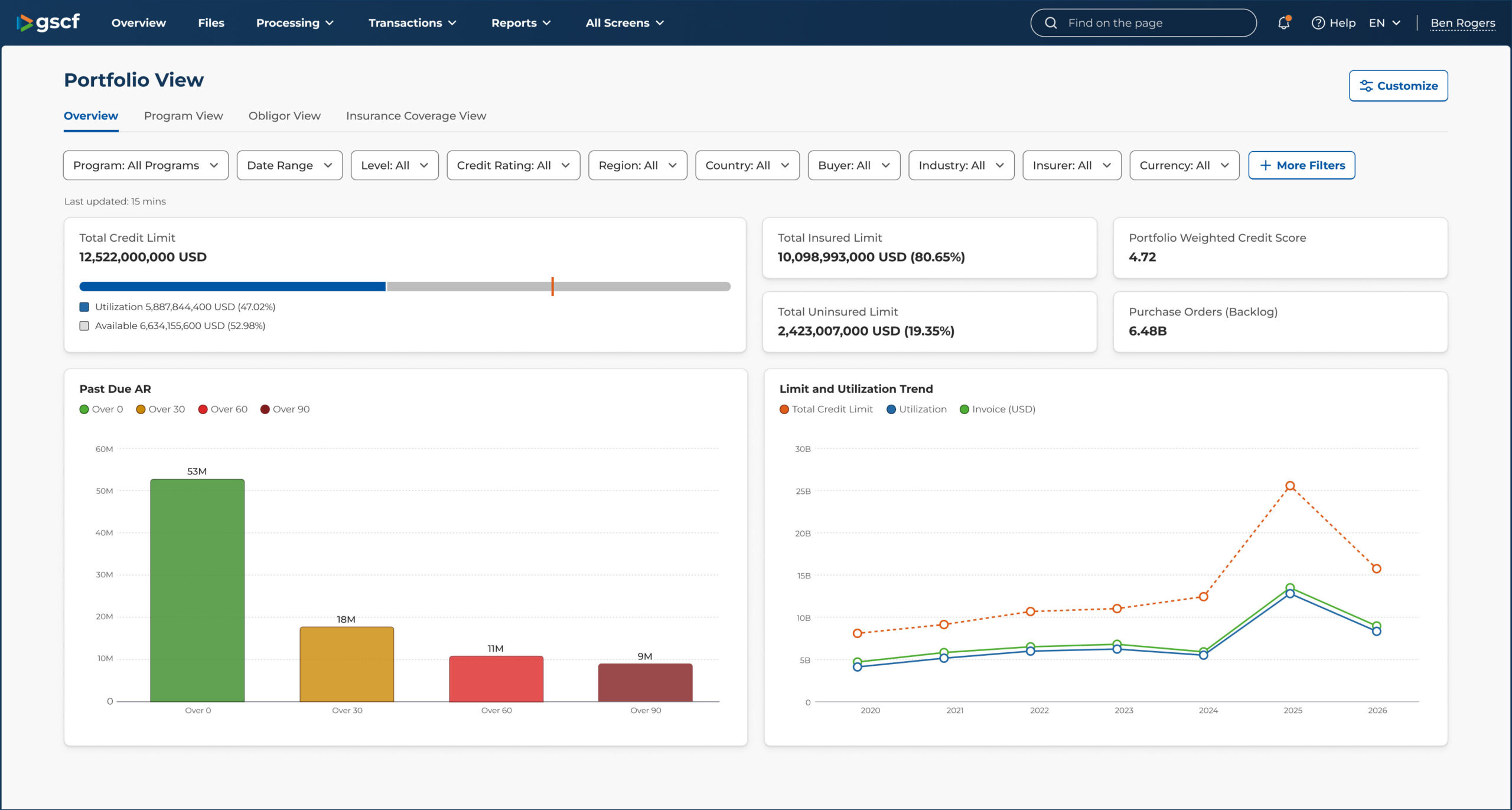
    1. Aggregated obligor exposure visibility across client programs, funders and counterparties, with normalized exposure definitions and built-in limit management and automated concentration controls
    2. Insured vs. retained vs participated exposure visibility across co-originated and participated positions
    3. Standardized global workflows with structured exception management
    4. A purpose-built control platform to handle structural complexity with standardized workflows, granular controls and a full audit trail for every change without needing to define workarounds
    5. Portfolio-level reporting and embedded decisioning that scale across regions and structures

    The Result: New client programs scale within established parameters. Onboarding timelines compress. Cost-to-serve doesn’t rise proportionally with volume. And when a client requests incremental capacity or a new region is added, credit teams can validate impact against consolidated portfolio exposure and respond faster, a competitive advantage in a market where deal speed matters.

    Frequently Asked Questions

    • Why do receivables and payables finance programs become harder to manage as they scale? As banks grow their receivables or finance portfolios across clients, regions, funding structures and insurer relationships, operational complexity increases. Operating models designed for individual programs can create fragmented exposure tracking, inconsistent workflows and manual reconciliation, making portfolio-level risk harder to identify and manage.
    • Why is consolidated obligor visibility important for banks? The same obligor can appear across multiple client programs, regions, insurers and financing structures. Consolidated obligor visibility gives banks a portfolio-level view of exposure, helping them identify concentration risk earlier, manage limits more effectively and respond faster to new capacity requests.
    • What capabilities do banks need to scale receivables or payables finance programs? Scaling receivables finance requires standardized workflows, consolidated obligor visibility and embedded decisioning across the portfolio. C4: Connected Capital Control Center brings these capabilities together, helping banks move from program-by-program oversight to portfolio-level management with greater visibility, control and confidence.

    Contact GSCF to discuss how to improve performance across your receivables finance portfolio..

    1 Basel Committee on Banking Supervision, Banks’ interconnections with non-bank financial intermediaries, BIS, July 2025. https://www.bis.org/bcbs/publ/d598.pdf

  • GSCF Launches C4: Connected Capital Control Center

    GSCF Launches C4: Connected Capital Control Center

    Delivering Visibility and Control to Corporates, Banks & Asset Managers

    RELEASE DATE: 26 March, 2026, 9:00 am EDT   

    NEW YORK, March 26, 2026 – GSCF, a leading global provider of working capital solutions, today announced the launch of Connected Capital Control Center (C4) – a servicing platform designed to help banks, asset managers and enterprise corporates originate, manage and analyze working capital with greater visibility, control and confidence across multiple programs.

    Built to support GSCF’s Connected Capital ecosystem and the broader market landscape, C4 addresses a growing market need: organizations are deploying multiple working capital programs across regions, funders, insurers and service providers, yet lack a single source of truth to track exposure, liquidity, cost and risk across their entire portfolio of programs.

    C4 consolidates program data and workflows into one unified control layer for programs serviced by GSCF or external providers, enabling financial institutions and enterprises to scale working capital more efficiently while reducing operational friction and risk.

    “As working capital portfolios grow more complex, fragmented views and manual oversight aren’t sustainable,” said Doug Morgan, Chief Executive Officer of GSCF. “C4 brings portfolio-level clarity to enterprises and their funding partners – so decisions can be made with confidence, limits can be enforced proactively, and working capital can be deployed more strategically across the global ecosystem.”

    C4 for Enterprise Corporates: Advanced Intelligence for the Office of the CFO
    For global enterprises relying on multiple working capital programs across regions, funders and administrators to drive liquidity and fuel growth, C4 provides a single, aggregated view of all working capital activity to eliminate data silos and enable centralized oversight.
    Key capabilities for corporates include:

    • Aggregated Data Views: A single source of truth consolidating all working capital programs, regardless of funder or platform
    • Portfolio-Level Intelligence: Holistic visibility across regions, buyers, suppliers and counterparties to support CFO- and Treasurer-level decisioning
    • Cross-Funder Transparency: Clear insight into funding flows, utilization and pricing across multiple banks and capital partners
    • Global Operational Workflows: Standardized and automated processes designed for multi-region, multi-funder environments
    • Exposure and Concentration Management: Program- and portfolio-level analytics to identify risk, adjust limits and optimize capital allocation

    By unifying data and decisioning at the portfolio level, C4 allows enterprises to move beyond reactive reporting and manage working capital as a strategic asset.

    C4 for Banks: Scaling Working Capital with Confidence and Control
    For trade finance and structured working capital teams, C4 delivers real-time visibility and embedded controls across multi-program and multi-funder portfolios to enable faster origination, stronger governance and scalable growth.
    Key capabilities for banks include:

    • Portfolio-Level Visibility: A consolidated, real-time view of exposure across obligors, regions, insurers and structures
    • Built-In Limit Management: Embedded credit limits, concentration thresholds, alerts and automated “pause” mechanisms
    • Streamlined Accounts Receivable: Standardized AR processes that scale from simple programs to complex, insured structures
    • Co-Origination and Extended Capacity: A unique combination of servicing expertise and funding capabilities that expands balance-sheet flexibility

    C4 empowers banks to shift from a model of program-by-program oversight to true portfolio management, reducing blind spots while increasing confidence in the ability to grow with efficiency and discipline.

    A Control Center Built for Scale, Not Silos
    Unlike today’s working capital landscape that can be fragmented across operations, technology and data, C4 is designed as a portfolio-level control layer that integrates technology with GSCF’s world-class managed services. Backed by more than 30 years of experience operating complex working capital programs globally, GSCF embeds operational precision directly into the platform – allowing clients to offload complexity while fully retaining control.

    “C4 addresses the needs of banks and enterprises today while supporting their growth across multiple programs, partners and jurisdictions,” said Shannon Dolan, Chief Product Officer of GSCF. “By consolidating data, limits, workflows and decisioning into one control center, C4 will help teams act faster, reduce risk and continuously optimize working capital performance at scale.”

    “The evolution of working capital management is moving beyond process efficiency toward liquidity orchestration. As enterprises and their financial partners deploy programs across an increasingly complex ecosystem of funders, regions and structures, the demand for portfolio-level visibility and control is intensifying. C4 reflects where the market is heading – a unified control layer that enables CFOs and Treasurers to manage liquidity not just as an operational necessity, but as a driver of business performance and resilience,” said Senior Research Director, IDC Enterprise Applications, Kevin Permenter.

    About GSCF

    GSCF is the leading global provider of working capital solutions. The Company enables corporates and financial partners to accelerate growth, unlock liquidity and manage the risk and complexity of the end-to-end working capital cycle. We originate, manage and analyze working capital programs through our innovative Working Capital as a Service offering, combining the power of a configurable and comprehensive technology platform, expert services and a Connected Capital ecosystem of alternative capital solutions and bank capital. GSCF’s team of working capital experts operates in over 75 countries to solve global working capital efficiency challenges. Visit www.gscf.com to learn more.

  • Why Data Integration Is the Hidden Constraint on Working Capital Performance 

    Why Data Integration Is the Hidden Constraint on Working Capital Performance 

    Across nearly every finding in GSCF’s Working Capital Leadership Report 2025, one theme stands out: data integration remains the primary bottleneck to working capital performance. 

    Only 10% of organizations report fully integrated, real-time data, while 50% describe their systems as only partially integrated, and 25% say they are not integrated at all. Even where automation exists, maturity remains limited: 40% report moderate automation, 36% basic and 23% none. 

    This fragmentation fuels manual processes, weak forecasting and limited visibility. The result is a growing gap between finance transformation and operational reality. 

    Leading corporates prioritize integration as the foundation of working capital performance. By connecting systems and aligning data, they transform reporting into real-time intelligence and liquidity into a strategic advantage. 

    Key Takeaways 

    • Fragmented data environments are the single biggest constraint on working capital performance. 
    • Automation without integration delivers limited value and often increases manual workarounds. 
    • Integrated data is the foundation that enables forecasting accuracy, funding optimization and cross-functional execution. 

    How GSCF Helps 

    GSCF aggregates transaction and program data to reduce manual processes and improve transparency and operational efficiency. 

    With C4 (Connected Capital Control Center) coming soon, this integration extends across the entire working capital portfolio, including programs and funders beyond GSCF. By consolidating data into a single, unified view, C4 enables organizations to manage working capital with greater control, consistency and confidence. 

    Learn more: Download the Working Capital Leadership Report 

  • Only 4% Have Real-Time Forecasting – Why Visibility Is the New Battleground 

    Only 4% Have Real-Time Forecasting – Why Visibility Is the New Battleground 

    In an environment defined by interest-rate volatility and supply-chain disruption, forecasting accuracy has become a strategic differentiator. Yet the data from GSCF’s Working Capital Leadership Report 2025 reveals a stark reality: only 4% of organizations have fully automated, real-time cash forecasting. 

    The majority are still operating with limited visibility. 53% rely on semi-automated forecasting with manual inputs, while 34% continue to use spreadsheet-based models. These approaches may have worked in a more stable environment, but they struggle under today’s conditions of rapid demand shifts and rising funding complexity. 

    This data gap has real consequences. Poor visibility makes it harder to anticipate liquidity shortfalls, optimize funding decisions, or respond proactively to disruption. It also forces treasury and finance teams into a reactive posture, managing cash after the fact rather than steering it strategically. 

    What sets the small cohort of high performers apart is not just technology, but mindset. Organizations with advanced forecasting capabilities are far more likely to report confidence in liquidity planning and faster decision-making cycles across finance, sales and operations. 

    As the report makes clear, forecasting is no longer a technical nice-to-have. It is the foundation on which resilient working capital strategies are built. 

    Key Takeaways 

    • Real-time forecasting remains rare, creating a widening gap between organizations that can anticipate liquidity risk and those that can only react to it. 
    • Reliance on spreadsheets and semi-automated processes is no longer just inefficient, it actively constrains agility in volatile markets. 
    • Data-driven maturity is becoming a strategic differentiator, not a treasury capability. 

    How GSCF Helps 

    GSCF’s Working Capital as a Service model combines technology, expert services and a Connected Capital ecosystem of alternative and bank capital to deliver visibility across all your global working capital programs. 

    With C4 (Connected Capital Control Center) coming soon, GSCF extends this visibility to the portfolio level, aggregating data across working capital programs, regions and funders into a single source of truth. This consolidated view improves forecasting confidence and enables finance leaders to assess liquidity position and exposure across the full working capital landscape rather than program by program. 

    Learn more: Download the Working Capital Leadership Report 

  • Avoiding Credit Market Pitfalls: How Data Transparency Drives Smarter Risk

    Avoiding Credit Market Pitfalls: How Data Transparency Drives Smarter Risk

    Recent developments in the credit markets have underscored the importance of robust risk management and data transparency. The First Brands situation, which resulted in losses for numerous funders due to double-pledged or fabricated receivables, has become a clear example of why thorough due diligence matters.

    GSCF’s Approach: Spotting Red Flags Early

    Over the past five years, GSCF was approached multiple times to participate in First Brands’ accounts receivable programs. Each time, our team of working capital, credit and risk experts – in addition to our Connected Capital platform and risk protocols – identified several high-level concerns, such as gaps in transparency, complexity in funder involvement and other risk factors. These red flags prompted us to pass on every opportunity, ensuring that GSCF maintained zero exposure to First Brands.

    How GSCF Helps Expand Risk Coverage

    • Proactive Risk Management: Our platform alongside our Credit and Capital Markets teams flag issues early, allowing us to avoid opportunities that don’t meet our standards – protecting our clients and partners from unnecessary risk.
    • Mitigate Counterparty Risk: Integrated credit and risk management tools help monitor buyer and supplier performance and give our corporate and bank partners the confidence to respond to early warning signals. 
    • Scale Globally with Confidence: For those managing global working capital programs, we can provide the data transparency and localized legal, regulatory and credit frameworks tailored to each market.

    While other funders are now managing the fallout from First Brands, GSCF’s proactive approach and commitment to transparency have kept our clients safe. We continue to lead the way in risk management, setting a new standard for accountability and data-driven decision making.

    The First Brands case highlights why data transparency and rigorous due diligence are essential in today’s credit market. With the combination of GSCF’s risk management experts and Connected Capital platform, our clients benefit from an ecosystem designed to prevent issues before they arise, ensuring confidence and security in every transaction.

    Best Practices for Navigating Today’s Credit Climate

    1. Prioritize Data Transparency: Insist on direct access to transaction-level data and historical payment records. Transparency is the foundation of effective risk management.
    2. Strengthen Due Diligence: Go beyond surface-level checks. Regularly review collateral, validate receivables and ensure there are no double pledges.
    3. Monitor Counterparty Performance: Use integrated tools to track buyer and supplier behavior and respond quickly to early warning signals.
    4. Diversify Funding Sources: Avoid over-reliance on a single funder or platform to reduce concentration risk. While diversification is important, ensure all parties are aligned on transparency and controls.


    If you’d like our team of working capital experts to conduct a proactive risk assessment of your working capital portfolio, reach out to us today. We’re here to help you navigate uncertainty and strengthen your risk controls with the power of data transparency.