

Tag: Working Capital as a Service

  • The Working Capital Portfolio Problem No One Has Solved – Until Now

    The Working Capital Portfolio Problem No One Has Solved – Until Now

    For decades, working capital has been managed one program at a time.

    A payables finance program here. An AR factoring facility there. Distribution finance running in parallel across three regions, serviced by two different providers, funded by a mix of banks and alternative capital. Each one functioning. Each one optimized in isolation. But none of them connected.

    This is the reality for most enterprise corporates and their financial partners today. And it’s not a technology gap, it’s a strategic one. The tools that exist were built to run programs. No one built a platform to manage portfolios.

    From Program Management to Portfolio Intelligence

    When working capital lives program-by-program, the decisions that matter most – where to deploy liquidity, where concentration risk is building, which funders are underutilized, which markets need more capacity – can’t be made with confidence. Finance teams are working from fragmented dashboards, manual reconciliations and reports that are out of date before they’re read.

    The result isn’t just inefficiency. It’s a structural blind spot at the portfolio-level, at precisely the moment when CFOs and Treasurers are being asked to manage working capital not as an operational function, but as a strategic lever for growth. The demand for portfolio-level visibility and control is intensifying, and yet most platforms are still optimizing the transaction.

    Four Gaps. One Platform.

    Over the past several years, we’ve worked closely with enterprise corporates, banks and asset managers to understand where the real friction lives. Four structural gaps emerged consistently, across geographies, industries and program types.

    The Visibility Gap. Organizations running multiple working capital programs simultaneously have no unified view. No single place to see utilization, exposure, program cost and available liquidity across all of it in real time. Decisions get made on incomplete information or not made at all.

    The Credit Gap. Banks are well-equipped to serve investment-grade working capital. But most enterprise supply and distribution chains include a significant population of non-investment grade, middle-market companies that fall outside bank credit range, and outside most platform capabilities. That represents an enormous underserved opportunity.

    The Buyer Adoption Gap. Every working capital program lives or dies on enrollment. Historically, onboarding is slow, opaque and not user-friendly. Programs chronically underperform because the user base never fully activates – not because the program wasn’t well-structured, but because the experience made adoption too difficult.

    The Integration Gap. Working capital programs remain largely disconnected from the ERP and P2P systems where underlying transaction data lives. Finance teams are making working capital decisions on stale, manually reconciled information, a problem that compounds as portfolios scale.

    These are not new problems. The market has lived with them for years. What’s new is that a single platform now exists to close all four gaps.

    Introducing C4: Connected Capital Control Center

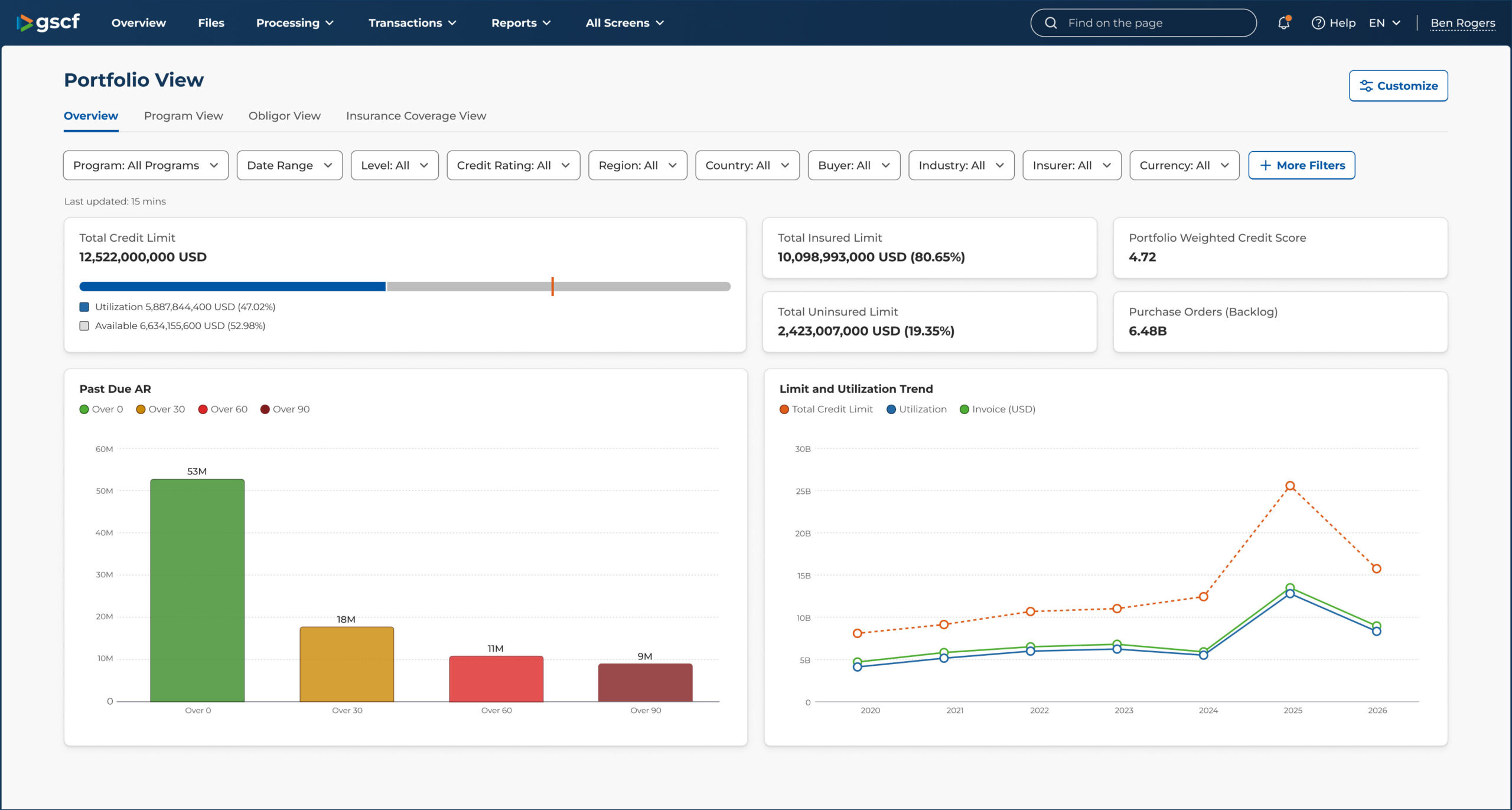
    Today, GSCF is launching C4: Connected Capital Control Center – our next-generation platform built to give enterprise corporates, banks and asset managers portfolio-level intelligence, real-time decisioning and unified control across every working capital program they run.

    C4 is not a reporting tool layered on top of existing infrastructure. It is the technology backbone of Working Capital as a Service – an end-to-end cloud-native control layer that integrates directly with the systems, funders and workflows that working capital programs depend on.

    For enterprise corporates, C4 delivers a single source of truth across all programs, regardless of funder or service provider. For banks and asset managers, it provides the portfolio-level visibility and embedded limit management needed to scale with confidence and discipline – shifting from program-by-program oversight to true portfolio governance.

    Working Capital as a Strategic Asset

    The evolution underway in working capital is not primarily about technology. It’s about how CFOs and Treasurers think about liquidity.

    The organizations that are ahead of the curve are not simply running better programs. They are orchestrating liquidity across funders, regions and program types as a source of competitive advantage. They are making proactive, data-driven decisions at the portfolio-level, managing concentration risk before it becomes a problem, and deploying capital where it creates the most value.

    C4 is built for that world.

    Greater visibility. Stronger control. Less complexity. That is what C4 delivers, and it is what working capital management has always needed.

    Explore C4

    Talk to an Expert

  • GSCF Launches C4: Connected Capital Control Center

    GSCF Launches C4: Connected Capital Control Center

    Delivering Visibility and Control to Corporates, Banks & Asset Managers

    RELEASE DATE: 26 March, 2026, 9:00 am EDT   

    NEW YORK, March 26, 2026 – GSCF, a leading global provider of working capital solutions, today announced the launch of Connected Capital Control Center (C4) – a servicing platform designed to help banks, asset managers and enterprise corporates originate, manage and analyze working capital with greater visibility, control and confidence across multiple programs.

    Built to support GSCF’s Connected Capital ecosystem and the broader market landscape, C4 addresses a growing market need: organizations are deploying multiple working capital programs across regions, funders, insurers and service providers, yet lack a single source of truth to track exposure, liquidity, cost and risk across their entire portfolio of programs.

    C4 consolidates program data and workflows into one unified control layer for programs serviced by GSCF or external providers, enabling financial institutions and enterprises to scale working capital more efficiently while reducing operational friction and risk.

    “As working capital portfolios grow more complex, fragmented views and manual oversight aren’t sustainable,” said Doug Morgan, Chief Executive Officer of GSCF. “C4 brings portfolio-level clarity to enterprises and their funding partners – so decisions can be made with confidence, limits can be enforced proactively, and working capital can be deployed more strategically across the global ecosystem.”

    C4 for Enterprise Corporates: Advanced Intelligence for the Office of the CFO
    For global enterprises relying on multiple working capital programs across regions, funders and administrators to drive liquidity and fuel growth, C4 provides a single, aggregated view of all working capital activity to eliminate data silos and enable centralized oversight.
    Key capabilities for corporates include:

    • Aggregated Data Views: A single source of truth consolidating all working capital programs, regardless of funder or platform
    • Portfolio-Level Intelligence: Holistic visibility across regions, buyers, suppliers and counterparties to support CFO- and Treasurer-level decisioning
    • Cross-Funder Transparency: Clear insight into funding flows, utilization and pricing across multiple banks and capital partners
    • Global Operational Workflows: Standardized and automated processes designed for multi-region, multi-funder environments
    • Exposure and Concentration Management: Program- and portfolio-level analytics to identify risk, adjust limits and optimize capital allocation

    By unifying data and decisioning at the portfolio level, C4 allows enterprises to move beyond reactive reporting and manage working capital as a strategic asset.

    C4 for Banks: Scaling Working Capital with Confidence and Control
    For trade finance and structured working capital teams, C4 delivers real-time visibility and embedded controls across multi-program and multi-funder portfolios to enable faster origination, stronger governance and scalable growth.
    Key capabilities for banks include:

    • Portfolio-Level Visibility: A consolidated, real-time view of exposure across obligors, regions, insurers and structures
    • Built-In Limit Management: Embedded credit limits, concentration thresholds, alerts and automated “pause” mechanisms
    • Streamlined Accounts Receivable: Standardized AR processes that scale from simple programs to complex, insured structures
    • Co-Origination and Extended Capacity: A unique combination of servicing expertise and funding capabilities that expands balance-sheet flexibility

    C4 empowers banks to shift from a model of program-by-program oversight to true portfolio management, reducing blind spots while increasing confidence in the ability to grow with efficiency and discipline.

    A Control Center Built for Scale, Not Silos
    Unlike today’s working capital landscape that can be fragmented across operations, technology and data, C4 is designed as a portfolio-level control layer that integrates technology with GSCF’s world-class managed services. Backed by more than 30 years of experience operating complex working capital programs globally, GSCF embeds operational precision directly into the platform – allowing clients to offload complexity while fully retaining control.

    “C4 addresses the needs of banks and enterprises today while supporting their growth across multiple programs, partners and jurisdictions,” said Shannon Dolan, Chief Product Officer of GSCF. “By consolidating data, limits, workflows and decisioning into one control center, C4 will help teams act faster, reduce risk and continuously optimize working capital performance at scale.”

    “The evolution of working capital management is moving beyond process efficiency toward liquidity orchestration. As enterprises and their financial partners deploy programs across an increasingly complex ecosystem of funders, regions and structures, the demand for portfolio-level visibility and control is intensifying. C4 reflects where the market is heading – a unified control layer that enables CFOs and Treasurers to manage liquidity not just as an operational necessity, but as a driver of business performance and resilience,” said Senior Research Director, IDC Enterprise Applications, Kevin Permenter.

    About GSCF

    GSCF is the leading global provider of working capital solutions. The Company enables corporates and financial partners to accelerate growth, unlock liquidity and manage the risk and complexity of the end-to-end working capital cycle. We originate, manage and analyze working capital programs through our innovative Working Capital as a Service offering, combining the power of a configurable and comprehensive technology platform, expert services and a Connected Capital ecosystem of alternative capital solutions and bank capital. GSCF’s team of working capital experts operates in over 75 countries to solve global working capital efficiency challenges. Visit www.gscf.com to learn more.

  • Only 4% Have Real-Time Forecasting – Why Visibility Is the New Battleground 

    Only 4% Have Real-Time Forecasting – Why Visibility Is the New Battleground 

    In an environment defined by interest-rate volatility and supply-chain disruption, forecasting accuracy has become a strategic differentiator. Yet the data from GSCF’s Working Capital Leadership Report 2025 reveals a stark reality: only 4% of organizations have fully automated, real-time cash forecasting. 

    The majority are still operating with limited visibility. 53% rely on semi-automated forecasting with manual inputs, while 34% continue to use spreadsheet-based models. These approaches may have worked in a more stable environment, but they struggle under today’s conditions of rapid demand shifts and rising funding complexity. 

    This data gap has real consequences. Poor visibility makes it harder to anticipate liquidity shortfalls, optimize funding decisions, or respond proactively to disruption. It also forces treasury and finance teams into a reactive posture, managing cash after the fact rather than steering it strategically. 

    What sets the small cohort of high performers apart is not just technology, but mindset. Organizations with advanced forecasting capabilities are far more likely to report confidence in liquidity planning and faster decision-making cycles across finance, sales and operations. 

    As the report makes clear, forecasting is no longer a technical nice-to-have. It is the foundation on which resilient working capital strategies are built. 

    Key Takeaways 

    • Real-time forecasting remains rare, creating a widening gap between organizations that can anticipate liquidity risk and those that can only react to it. 
    • Reliance on spreadsheets and semi-automated processes is no longer just inefficient, it actively constrains agility in volatile markets. 
    • Data-driven maturity is becoming a strategic differentiator, not a treasury capability. 

    How GSCF Helps 

    GSCF’s Working Capital as a Service model combines technology, expert services and a Connected Capital ecosystem of alternative and bank capital to deliver visibility across all your global working capital programs. 

    With C4 (Connected Capital Control Center) coming soon, GSCF extends this visibility to the portfolio level, aggregating data across working capital programs, regions and funders into a single source of truth. This consolidated view improves forecasting confidence and enables finance leaders to assess liquidity position and exposure across the full working capital landscape rather than program by program. 

    Learn more: Download the Working Capital Leadership Report 

  • Avoiding Credit Market Pitfalls: How Data Transparency Drives Smarter Risk

    Avoiding Credit Market Pitfalls: How Data Transparency Drives Smarter Risk

    Recent developments in the credit markets have underscored the importance of robust risk management and data transparency. The First Brands situation, which resulted in losses for numerous funders due to double-pledged or fabricated receivables, has become a clear example of why thorough due diligence matters.

    GSCF’s Approach: Spotting Red Flags Early

    Over the past five years, GSCF was approached multiple times to participate in First Brands’ accounts receivable programs. Each time, our team of working capital, credit and risk experts – in addition to our Connected Capital platform and risk protocols – identified several high-level concerns, such as gaps in transparency, complexity in funder involvement and other risk factors. These red flags prompted us to pass on every opportunity, ensuring that GSCF maintained zero exposure to First Brands.

    How GSCF Helps Expand Risk Coverage

    • Proactive Risk Management: Our platform alongside our Credit and Capital Markets teams flag issues early, allowing us to avoid opportunities that don’t meet our standards – protecting our clients and partners from unnecessary risk.
    • Mitigate Counterparty Risk: Integrated credit and risk management tools help monitor buyer and supplier performance and give our corporate and bank partners the confidence to respond to early warning signals. 
    • Scale Globally with Confidence: For those managing global working capital programs, we can provide the data transparency and localized legal, regulatory and credit frameworks tailored to each market.

    While other funders are now managing the fallout from First Brands, GSCF’s proactive approach and commitment to transparency have kept our clients safe. We continue to lead the way in risk management, setting a new standard for accountability and data-driven decision making.

    The First Brands case highlights why data transparency and rigorous due diligence are essential in today’s credit market. With the combination of GSCF’s risk management experts and Connected Capital platform, our clients benefit from an ecosystem designed to prevent issues before they arise, ensuring confidence and security in every transaction.

    Best Practices for Navigating Today’s Credit Climate

    1. Prioritize Data Transparency: Insist on direct access to transaction-level data and historical payment records. Transparency is the foundation of effective risk management.
    2. Strengthen Due Diligence: Go beyond surface-level checks. Regularly review collateral, validate receivables and ensure there are no double pledges.
    3. Monitor Counterparty Performance: Use integrated tools to track buyer and supplier behavior and respond quickly to early warning signals.
    4. Diversify Funding Sources: Avoid over-reliance on a single funder or platform to reduce concentration risk. While diversification is important, ensure all parties are aligned on transparency and controls.


    If you’d like our team of working capital experts to conduct a proactive risk assessment of your working capital portfolio, reach out to us today. We’re here to help you navigate uncertainty and strengthen your risk controls with the power of data transparency.

  • From Tactical to Strategic: Why Data is Reshaping Working Capital

    From Tactical to Strategic: Why Data is Reshaping Working Capital

    Most companies still treat working capital as a tactical fix – patching up cash flow with manual processes and fragmented data. But a preview of the upcoming Working Capital Leadership Report shows a clear shift: leaders are using automation and integrated data to turn working capital into a strategic growth engine.

    Early findings from the 2025 survey:

    • Manual processes and poor data integration are holding companies back. Nearly 50% cite inefficient processes as their top challenge, and only 10% have fully integrated, real-time data across finance, procurement and operations.
    • Forecasting is still lagging. Over half (52%) rely on semi-automated systems with manual inputs, and almost a third (31%) still use spreadsheets. Just 4% have fully automated, real-time forecasting.
    • Automation is advancing, but slowly. 40% report moderate automation (like RPA), but 23% have none at all. No respondents claim advanced AI-driven automation yet.
    • Funding is diversifying. 20% of companies now source liquidity from multiple funders, including non-bank partners, while banks still anchor 62% of working capital programs.

    Why does this matter?

    • Companies that move from tactical fixes to strategic integration report faster cash conversion cycles, better forecasts and stronger supplier relationships.
    • Working capital champions use data-led decision-making, cross-functional collaboration and executive sponsorship to drive measurable business impact.

    Bottom line:
    The future belongs to those who automate, integrate and collaborate. Tactical tools solve today’s problems; technology, data and multiple funding sources unlock tomorrow’s growth.

  • Resilient Working Capital Strategies in a Tariff-Impacted Economy

    Resilient Working Capital Strategies in a Tariff-Impacted Economy

    In today’s interconnected global economy, tariffs have become a critical factor affecting business operations and financial strategies. Companies with complex supply chains are particularly vulnerable to the effects of tariffs, requiring them to adapt their working capital strategies to maintain financial stability and drive growth.

    Challenges Posed by Tariffs in Complex Supply Chains

    1. Increased Costs: Tariffs raise the cost of imported goods, squeezing profit margins. Companies may need to pass these costs onto consumers, potentially reducing demand for their products.
    2. Supply Chain Disruptions: Tariffs can lead to supply chain disruptions as companies seek alternative sources for materials. This can result in delays and increased costs associated with finding new suppliers.
    3. Cash Flow Management: Higher costs and supply chain disruptions can strain a company’s cash flow. Effective working capital management becomes crucial to ensure liquidity and maintain operations.

    Strategies to Mitigate Tariff Impacts

    1. Diversifying Suppliers: Companies can reduce their reliance on tariff-affected imports by diversifying their supplier base. This can help mitigate the risk of supply chain disruptions and manage costs more effectively
    2. Negotiating with Suppliers: Engaging in negotiations with suppliers to secure better terms or bulk discounts can help offset the increased costs due to tariffs
    3. Optimizing Inventory Management: Efficient inventory management can help companies maintain optimal levels, reducing the need for expensive imports and minimizing the impact of tariffs on cash flow
    4. Adjusting Pricing Strategies: Companies may need to adjust their pricing strategies to reflect the increased costs. This can involve passing some of the costs onto consumers or finding ways to absorb them without significantly affecting profit margins

    Unlocking Liquidity and Driving Sales Growth with Connected Capital

    GSCF offers innovative Working Capital as a Service solutions to help companies navigate the complexities of tariffs and create, manage and analyze working capital programs. GSCF’s technology, expert services and Connected Capital ecosystem integrate alternative capital and bank financing, providing a comprehensive platform for managing liquidity and driving growth.

    1. Access to Alternative Capital Sources: GSCF’s platform allows businesses to complement their core bank funding with access to alternative capital. This hybrid approach provides flexibility and stability, enabling companies to manage cash flow, extend payment terms, and respond quickly to changing market conditions.
    2. Enhanced Risk Management: By integrating multiple funding sources, GSCF offers broad-spectrum risk coverage. Advanced analytics and risk management tools provide greater visibility into supply chain and financial performance, mitigating potential risks and ensuring business continuity.
    3. Improved Cash Flow and Liquidity: GSCF’s Connected Capital helps businesses unlock liquidity by optimizing cash conversion cycles. This frees up working capital for strategic reinvestment, supporting sustainable growth and improving cash flow.
    4. Scalability and Growth: GSCF’s solutions are designed to support businesses at every stage of their growth journey. From emerging markets to large enterprises, Connected Capital provides scalable solutions that drive revenue acceleration and market expansion.

    Tariffs present a complex challenge for businesses, especially those with intricate supply chains. By leveraging GSCF’s Working Capital as a Service solutions, enterprises and growth corporates can access alternative capital sources, unlock liquidity, and use working capital to drive sales growth. These strategies enable businesses to navigate the impact of tariffs on their supply chains and continue to thrive in a competitive global market.