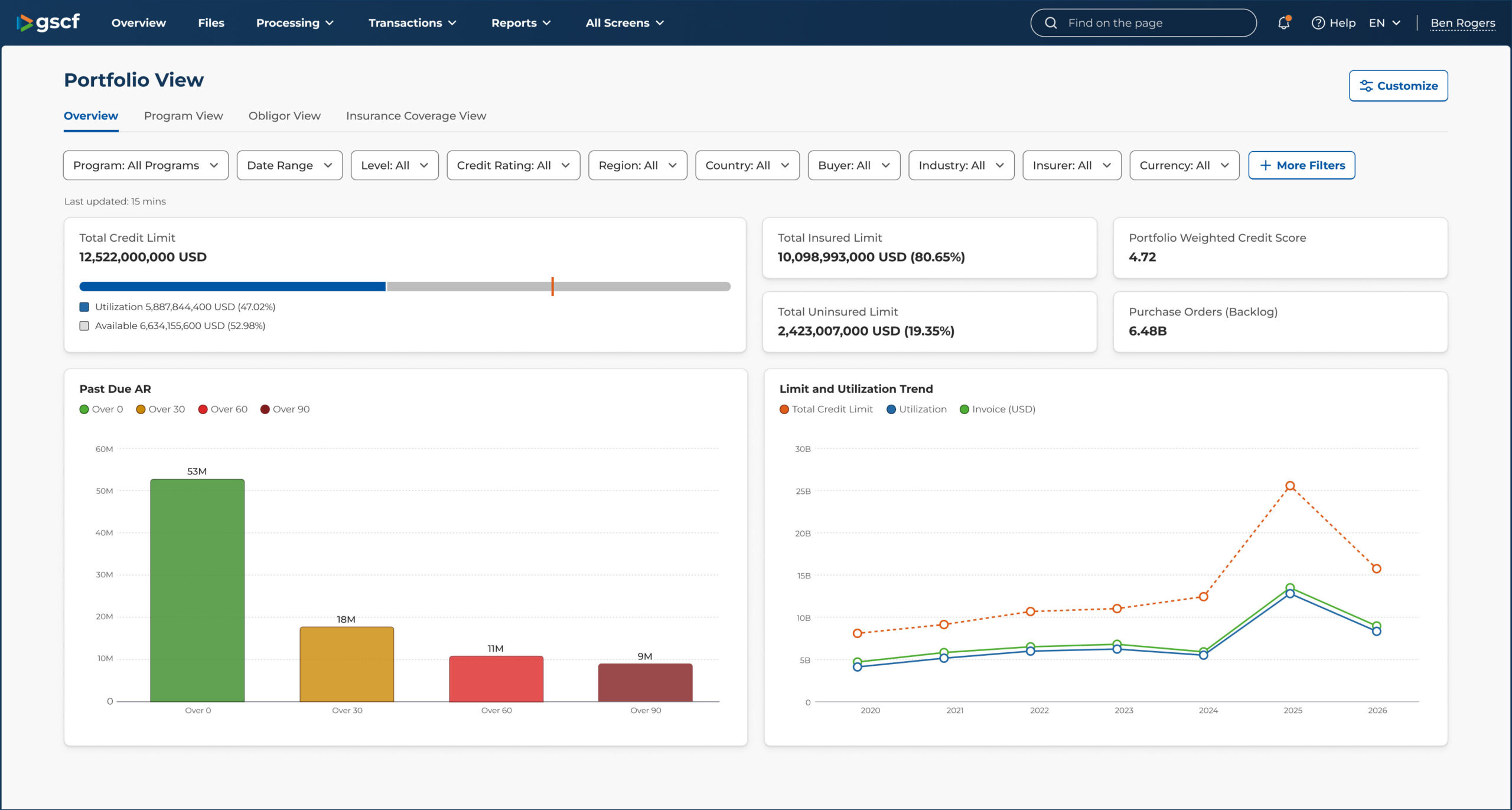

Tag: C4

  • The Operational Side of Scaling AR Programs

    The Operational Side of Scaling AR Programs

    Every new client, insurer, or funding structure adds a layer. For banks running receivables and payables finance portfolios, those layers become the problem faster than you think.

    Receivables finance programs rarely fail because of a bad deal. They stall and can eventually break because the operating model underneath them was never built to scale.

    As banks grow their AR portfolios across clients, regions, funding structures and insurer relationships, friction compounds beneath the surface. Onboarding a new enterprise client brings its own insurance structure, approval hierarchy and limit logic. A new regional program means a new set of validation rules. A new capital participant adds another reconciliation touchpoint. Each addition feels manageable in isolation, but across 10 programs spanning multiple geographies, it no longer is.

    The result is predictable. Operational exceptions multiply faster than the deals generating them, onboarding timelines stretch, and analyst capacity gets absorbed by reconciliation work that adds no strategic value while creating blind spots where risk accumulates and decision-makers lose confidence.

    Program-by-Program Oversight Doesn’t Scale

    The core challenge for banks scaling receivables finance is that most operational models were designed for individual programs, not portfolios.

    When limit enforcement lives at the program level, concentration can build across parallel client structures without triggering a single alert; when onboarding logic isn’t standardized, each new client effectively rebuilds the control framework from scratch; when exposure definitions vary by program and risk takers use multiple insurance policy structures and syndications, consolidated portfolio views require manual reconciliation and are always a step behind.

    The Bank for International Settlements1 has flagged the structural dimension of this challenge directly: as banks’ linkages with non-bank financial intermediaries deepen, the ability to aggregate and monitor exposures across structures becomes both a supervisory and operational imperative. Without unified exposure frameworks, risk accumulates invisibly across programs and participants.

    What Portfolio-Level Control Actually Looks Like for Banks

    Scaling receivables finance with efficiency requires three things working together:

    • Standardized workflows across client structures. Exposure definitions normalized at intake. Limit logic applied consistently across all client programs, not rebuilt independently for each one. Exception management automated where risk is low, so credit and operations teams focus on decisions that actually require judgment.
    • Consolidated obligor visibility across programs, regions, and insurers. A single obligor appearing across three regional client programs may look within threshold in each and well above it in aggregate. That aggregation has to work across the full operating reality: group entities and geographies; country and political risk based on where trading actually happens; parental guarantees that change the credit picture; and the bank’s existing exposures to the same client across different financing structures and regional systems. Without seamless consolidation across those dimensions, true client and obligor risk stays fragmented and concentration breaches remain hidden until they surface in committee. With it, exposure is identified early and limit adjustments happen before thresholds are crossed.
    • Embedded decisioning, not periodic reporting. Reporting tells you what happened. Embedded decisioning changes what happens next. When concentration alerts trigger automatically before thresholds are approached, when a limit increase request can be validated against consolidated obligor exposure in minutes rather than days, origination teams move faster and with greater confidence. For banks competing on responsiveness, that difference is measurable.

    From Program Management to Portfolio Control

    GSCF’s C4: Connected Capital Control Center was built specifically for this transition – from program-by-program oversight to true portfolio management across a bank’s receivables finance book.

    Because GSCF manages the platform on behalf of banks and their corporate clients, the operational complexity sits with us, not with the bank’s internal teams. Banks get the portfolio-level visibility and control they need without taking on the servicing burden of managing it themselves. C4’s platform core capabilities include:

    1. Aggregated obligor exposure visibility across client programs, funders and counterparties, with normalized exposure definitions and built-in limit management and automated concentration controls
    2. Insured vs. retained vs participated exposure visibility across co-originated and participated positions
    3. Standardized global workflows with structured exception management
    4. A purpose-built control platform to handle structural complexity with standardized workflows, granular controls and a full audit trail for every change without needing to define workarounds
    5. Portfolio-level reporting and embedded decisioning that scale across regions and structures

    The result: new client programs scale within established parameters. Onboarding timelines compress. Cost-to-serve doesn’t rise proportionally with volume. And when a client requests incremental capacity or a new region is added, credit teams can validate impact against consolidated portfolio exposure and respond faster, a competitive advantage in a market where deal speed matters.

    See It in Practice

    The use case below shows how one bank made this transition – moving from program-by-program reporting to true portfolio-level oversight, and what that meant for their trade finance and credit teams day-to-day.

    A few of the questions it addresses:

    • How do you get real-time insight into obligor exposure across client programs, insurers and geographies?
    • How do you embed credit limits, concentration thresholds and automated alerts directly into operations so governance scales with portfolio growth?
    • How do you onboard new AR programs without rebuilding operational workflows each time?

    GSCF’s C4: Connected Capital Control Center is our next-generation servicing platform purpose-built to help banks, asset managers and enterprise corporates originate, manage and analyze working capital programs with greater visibility, control and confidence. Learn more at www.gscf.com.1 Basel Committee on Banking Supervision, Banks’ interconnections with non-bank financial intermediaries, BIS, July 2025. https://www.bis.org/bcbs/publ/d598.pdf

  • The Working Capital Portfolio Problem No One Has Solved – Until Now

    The Working Capital Portfolio Problem No One Has Solved – Until Now

    For decades, working capital has been managed one program at a time.

    A payables finance program here. An AR factoring facility there. Distribution finance running in parallel across three regions, serviced by two different providers, funded by a mix of banks and alternative capital. Each one functioning. Each one optimized in isolation. But none of them connected.

    This is the reality for most enterprise corporates and their financial partners today. And it’s not a technology gap, it’s a strategic one. The tools that exist were built to run programs. No one built a platform to manage portfolios.

    From Program Management to Portfolio Intelligence

    When working capital lives program-by-program, the decisions that matter most – where to deploy liquidity, where concentration risk is building, which funders are underutilized, which markets need more capacity – can’t be made with confidence. Finance teams are working from fragmented dashboards, manual reconciliations and reports that are out of date before they’re read.

    The result isn’t just inefficiency. It’s a structural blind spot at the portfolio-level, at precisely the moment when CFOs and Treasurers are being asked to manage working capital not as an operational function, but as a strategic lever for growth. The demand for portfolio-level visibility and control is intensifying, and yet most platforms are still optimizing the transaction.

    Four Gaps. One Platform.

    Over the past several years, we’ve worked closely with enterprise corporates, banks and asset managers to understand where the real friction lives. Four structural gaps emerged consistently, across geographies, industries and program types.

    The Visibility Gap. Organizations running multiple working capital programs simultaneously have no unified view. No single place to see utilization, exposure, program cost and available liquidity across all of it in real time. Decisions get made on incomplete information or not made at all.

    The Credit Gap. Banks are well-equipped to serve investment-grade working capital. But most enterprise supply and distribution chains include a significant population of non-investment grade, middle-market companies that fall outside bank credit range, and outside most platform capabilities. That represents an enormous underserved opportunity.

    The Buyer Adoption Gap. Every working capital program lives or dies on enrollment. Historically, onboarding is slow, opaque and not user-friendly. Programs chronically underperform because the user base never fully activates – not because the program wasn’t well-structured, but because the experience made adoption too difficult.

    The Integration Gap. Working capital programs remain largely disconnected from the ERP and P2P systems where underlying transaction data lives. Finance teams are making working capital decisions on stale, manually reconciled information, a problem that compounds as portfolios scale.

    These are not new problems. The market has lived with them for years. What’s new is that a single platform now exists to close all four gaps.

    Introducing C4: Connected Capital Control Center

    Today, GSCF is launching C4: Connected Capital Control Center – our next-generation platform built to give enterprise corporates, banks and asset managers portfolio-level intelligence, real-time decisioning and unified control across every working capital program they run.

    C4 is not a reporting tool layered on top of existing infrastructure. It is the technology backbone of Working Capital as a Service – an end-to-end cloud-native control layer that integrates directly with the systems, funders and workflows that working capital programs depend on.

    For enterprise corporates, C4 delivers a single source of truth across all programs, regardless of funder or service provider. For banks and asset managers, it provides the portfolio-level visibility and embedded limit management needed to scale with confidence and discipline – shifting from program-by-program oversight to true portfolio governance.

    Working Capital as a Strategic Asset

    The evolution underway in working capital is not primarily about technology. It’s about how CFOs and Treasurers think about liquidity.

    The organizations that are ahead of the curve are not simply running better programs. They are orchestrating liquidity across funders, regions and program types as a source of competitive advantage. They are making proactive, data-driven decisions at the portfolio-level, managing concentration risk before it becomes a problem, and deploying capital where it creates the most value.

    C4 is built for that world.

    Greater visibility. Stronger control. Less complexity. That is what C4 delivers, and it is what working capital management has always needed.

    Explore C4

    Talk to an Expert

  • GSCF Launches C4: Connected Capital Control Center

    GSCF Launches C4: Connected Capital Control Center

    Delivering Visibility and Control to Corporates, Banks & Asset Managers

    RELEASE DATE: 26 March, 2026, 9:00 am EDT   

    NEW YORK, March 26, 2026 – GSCF, a leading global provider of working capital solutions, today announced the launch of Connected Capital Control Center (C4) – a servicing platform designed to help banks, asset managers and enterprise corporates originate, manage and analyze working capital with greater visibility, control and confidence across multiple programs.

    Built to support GSCF’s Connected Capital ecosystem and the broader market landscape, C4 addresses a growing market need: organizations are deploying multiple working capital programs across regions, funders, insurers and service providers, yet lack a single source of truth to track exposure, liquidity, cost and risk across their entire portfolio of programs.

    C4 consolidates program data and workflows into one unified control layer for programs serviced by GSCF or external providers, enabling financial institutions and enterprises to scale working capital more efficiently while reducing operational friction and risk.

    “As working capital portfolios grow more complex, fragmented views and manual oversight aren’t sustainable,” said Doug Morgan, Chief Executive Officer of GSCF. “C4 brings portfolio-level clarity to enterprises and their funding partners – so decisions can be made with confidence, limits can be enforced proactively, and working capital can be deployed more strategically across the global ecosystem.”

    C4 for Enterprise Corporates: Advanced Intelligence for the Office of the CFO
    For global enterprises relying on multiple working capital programs across regions, funders and administrators to drive liquidity and fuel growth, C4 provides a single, aggregated view of all working capital activity to eliminate data silos and enable centralized oversight.
    Key capabilities for corporates include:

    • Aggregated Data Views: A single source of truth consolidating all working capital programs, regardless of funder or platform
    • Portfolio-Level Intelligence: Holistic visibility across regions, buyers, suppliers and counterparties to support CFO- and Treasurer-level decisioning
    • Cross-Funder Transparency: Clear insight into funding flows, utilization and pricing across multiple banks and capital partners
    • Global Operational Workflows: Standardized and automated processes designed for multi-region, multi-funder environments
    • Exposure and Concentration Management: Program- and portfolio-level analytics to identify risk, adjust limits and optimize capital allocation

    By unifying data and decisioning at the portfolio level, C4 allows enterprises to move beyond reactive reporting and manage working capital as a strategic asset.

    C4 for Banks: Scaling Working Capital with Confidence and Control
    For trade finance and structured working capital teams, C4 delivers real-time visibility and embedded controls across multi-program and multi-funder portfolios to enable faster origination, stronger governance and scalable growth.
    Key capabilities for banks include:

    • Portfolio-Level Visibility: A consolidated, real-time view of exposure across obligors, regions, insurers and structures
    • Built-In Limit Management: Embedded credit limits, concentration thresholds, alerts and automated “pause” mechanisms
    • Streamlined Accounts Receivable: Standardized AR processes that scale from simple programs to complex, insured structures
    • Co-Origination and Extended Capacity: A unique combination of servicing expertise and funding capabilities that expands balance-sheet flexibility

    C4 empowers banks to shift from a model of program-by-program oversight to true portfolio management, reducing blind spots while increasing confidence in the ability to grow with efficiency and discipline.

    A Control Center Built for Scale, Not Silos
    Unlike today’s working capital landscape that can be fragmented across operations, technology and data, C4 is designed as a portfolio-level control layer that integrates technology with GSCF’s world-class managed services. Backed by more than 30 years of experience operating complex working capital programs globally, GSCF embeds operational precision directly into the platform – allowing clients to offload complexity while fully retaining control.

    “C4 addresses the needs of banks and enterprises today while supporting their growth across multiple programs, partners and jurisdictions,” said Shannon Dolan, Chief Product Officer of GSCF. “By consolidating data, limits, workflows and decisioning into one control center, C4 will help teams act faster, reduce risk and continuously optimize working capital performance at scale.”

    “The evolution of working capital management is moving beyond process efficiency toward liquidity orchestration. As enterprises and their financial partners deploy programs across an increasingly complex ecosystem of funders, regions and structures, the demand for portfolio-level visibility and control is intensifying. C4 reflects where the market is heading – a unified control layer that enables CFOs and Treasurers to manage liquidity not just as an operational necessity, but as a driver of business performance and resilience,” said Senior Research Director, IDC Enterprise Applications, Kevin Permenter.

    About GSCF

    GSCF is the leading global provider of working capital solutions. The Company enables corporates and financial partners to accelerate growth, unlock liquidity and manage the risk and complexity of the end-to-end working capital cycle. We originate, manage and analyze working capital programs through our innovative Working Capital as a Service offering, combining the power of a configurable and comprehensive technology platform, expert services and a Connected Capital ecosystem of alternative capital solutions and bank capital. GSCF’s team of working capital experts operates in over 75 countries to solve global working capital efficiency challenges. Visit www.gscf.com to learn more.

  • Multi-Funding Solutions for Dynamic Liquidity

    Multi-Funding Solutions for Dynamic Liquidity

    The way corporates fund working capital is evolving rapidly. While traditional bank financing remains important, GSCF’s Working Capital Leadership Report 2025 shows a clear shift toward diversified funding structures.

    50% of respondents use receivables finance or factoring, 33% have adopted supply chain finance, and 24% now fund working capital programs through multiple sources. At the same time, 23% report using none of these tools — often due to execution and operational complexity rather than lack of awareness.

    Diversification brings flexibility. But it also introduces fragmentation.

    As organizations blend bank and alternative capital, the challenge shifts from access to liquidity to maintaining portfolio-level visibility, governance and control across multiple programs, funders and structures.

    Liquidity is no longer managed program by program. It must be managed at the portfolio level.

    The leaders are those who treat funding strategy as a lever but pair diversification with unified oversight. Without centralized visibility, multi-funding strategies can create blind spots in exposure, concentration risk and allocation.


    Key Takeaways

    • Diversified funding increases flexibility and increases structural complexity.
    • Fragmented ecosystems require portfolio-level visibility and governance.
    • Execution complexity, not lack of solutions, is what limits advancement.

    How GSCF Helps

    GSCF’s Connected Capital ecosystem simplifies access to both bank and alternative capital solutions within a unified platform.

    C4 (Connected Capital Control Center), coming soon, serves as the portfolio-level control layer across diversified funding programs — enabling real-time visibility into exposure, concentration risk and capital allocation across multiple funders and structures.

    This allows organizations to pursue multi-funding strategies with confidence, without sacrificing operational efficiency or governance.

    Learn more: Download the Working Capital Leadership Report 

  • Why 24% Are Pulling Ahead — The Rise of the Working Capital Champions

    Why 24% Are Pulling Ahead — The Rise of the Working Capital Champions

    Not all organizations are progressing at the same pace. The 2025 data from GSCF’s Working Capital Leadership Report identify a distinct group. 24% of respondents are classified as “Working Capital Champions,” and are setting a new standard for liquidity leadership. 

    What differentiates these leaders is not access to more tools and data, but how they use them. Champions are significantly more likely to report advanced automation, cross-functional ownership and executive sponsorship of working capital initiatives. 

    The impact is tangible. Champions consistently report stronger confidence in forecasts, faster cash conversion cycles and more resilient supplier relationships. Rather than relying on blanket term extensions, they segment suppliers and align payment strategies to risk and value. 

    For companies still early in their journey, the message is clear: progress does not start with perfection. It starts with leadership, collaboration and a commitment to treating working capital as a strategic asset. 

    Key Takeaways 

    • Working Capital Champions differentiate themselves through data, governance, leadership and collaboration rather than tools alone. 
    • Executive sponsorship and cross-functional ownership are consistent traits among high performers. 
    • Sustainable liquidity improvement is cultural as much as it is technical. 

    How GSCF Helps 

    GSCF provides a single platform to originate, manage and analyze working capital programs, replacing fragmented systems and data with connected operational insight. 

    With C4 (Connected Capital Control Center), coming soon, Working Capital Champions gain centralized governance and oversight across global working capital portfolios, supporting executive sponsorship and disciplined execution. C4 provides leadership teams with a consistent, portfolio-wide view of working capital performance and exposure, reinforcing data discipline and cross-functional alignment. 

    Learn more: Download the Working Capital Leadership Report 

  • From Balance Sheets to Business Strategy — Why Working Capital Is No Longer a Back-Office Metric

    From Balance Sheets to Business Strategy — Why Working Capital Is No Longer a Back-Office Metric

    Working capital has officially moved into the strategic spotlight. According to GSCF’s Working Capital Leadership Report 2025, 75% of companies review working capital metrics at least quarterly, and 38% now do so monthly, which is a clear signal that liquidity is becoming part of the management rhythm. 

    But reviewing metrics is only the first step. While 65% track Days Sales Outstanding (DSO) and 48% track Days Payables Outstanding (DPO), far fewer monitor integrated indicators such as the Cash Conversion Cycle (38%). These metrics tell the full story of how cash moves through the business, yet they remain underutilized. 

    The data highlights a growing divide between organizations that measure working capital and those that act on it. Fragmented systems remain a major barrier, with only 10% reporting fully integrated, real-time data across finance, procurement, and ERP platforms. 

    By contrast, advanced organizations embed working capital metrics into everyday decisions. Procurement policies and customer terms are all informed by cash impact. In these businesses, working capital has evolved from a set of ratios into a shared language across the enterprise. 

    Key Takeaways 

    • Reviewing working capital metrics more frequently has not automatically translated into better decision-making. 
    • Organizations that fail to track integrated measures like Cash Conversion Cycle are managing symptoms, not the system. 
    • Data integration, not metric availability, is the real barrier between visibility and action. 

    How GSCF Helps 

    GSCF provides a single platform to originate, manage and analyze working capital programs, replacing fragmented data, systems and processes with connected operational insight. 

    C4 (Connected Capital Control Center), coming soon, builds this foundation by standardizing portfolio-level monitoring and analytics across all working capital programs, including those outside of GSCF. By consolidating performance, exposure and utilization data, C4 enables working capital metrics to be used consistently across finance, treasury, procurement, channel sales and supply chain functions. 

    Learn more: Download the Working Capital Leadership Report

  • Only 4% Have Real-Time Forecasting – Why Visibility Is the New Battleground 

    Only 4% Have Real-Time Forecasting – Why Visibility Is the New Battleground 

    In an environment defined by interest-rate volatility and supply-chain disruption, forecasting accuracy has become a strategic differentiator. Yet the data from GSCF’s Working Capital Leadership Report 2025 reveals a stark reality: only 4% of organizations have fully automated, real-time cash forecasting. 

    The majority are still operating with limited visibility. 53% rely on semi-automated forecasting with manual inputs, while 34% continue to use spreadsheet-based models. These approaches may have worked in a more stable environment, but they struggle under today’s conditions of rapid demand shifts and rising funding complexity. 

    This data gap has real consequences. Poor visibility makes it harder to anticipate liquidity shortfalls, optimize funding decisions, or respond proactively to disruption. It also forces treasury and finance teams into a reactive posture, managing cash after the fact rather than steering it strategically. 

    What sets the small cohort of high performers apart is not just technology, but mindset. Organizations with advanced forecasting capabilities are far more likely to report confidence in liquidity planning and faster decision-making cycles across finance, sales and operations. 

    As the report makes clear, forecasting is no longer a technical nice-to-have. It is the foundation on which resilient working capital strategies are built. 

    Key Takeaways 

    • Real-time forecasting remains rare, creating a widening gap between organizations that can anticipate liquidity risk and those that can only react to it. 
    • Reliance on spreadsheets and semi-automated processes is no longer just inefficient, it actively constrains agility in volatile markets. 
    • Data-driven maturity is becoming a strategic differentiator, not a treasury capability. 

    How GSCF Helps 

    GSCF’s Working Capital as a Service model combines technology, expert services and a Connected Capital ecosystem of alternative and bank capital to deliver visibility across all your global working capital programs. 

    With C4 (Connected Capital Control Center) coming soon, GSCF extends this visibility to the portfolio level, aggregating data across working capital programs, regions and funders into a single source of truth. This consolidated view improves forecasting confidence and enables finance leaders to assess liquidity position and exposure across the full working capital landscape rather than program by program. 

    Learn more: Download the Working Capital Leadership Report